What is EDU-Port Japan?
In the field of education, Japan has great potential to contribute to the world.

“Primary and secondary education system” that builds excellent academic skills as well as manners and morals

High quality “math and science education” “ICT Education”

“Industrial human resource development” in institutes of technology and specialized schools

- EDU-Port Japan is a public-private, nationwide initiative to proactively introduce Japanese-style education overseas.
Since its launch in fiscal year 2016, the Public-Private Collaboration Platform for Japanese-style Education has served as a forum for collaboration among the Ministry of Education, Culture, Sports, Science and Technology (MEXT), the Ministry of Economy, Trade and Industry (METI), the Ministry of Foreign Affairs (MOFA), the Japan International Cooperation Agency (JICA) and local governments, educational institutions, private companies, NGOs, and other stakeholders.
The project has held public-private expert committee meetings to develop future directions and implementation strategies, facilitated discussions and information sharing among stakeholders through symposiums and other events, and disseminated information both domestically and internationally. Additionally, it has supported Japanese educational institutions and private companies in leveraging their teaching methods and content to contribute to educational reforms in various countries and the internationalization of Japanese education. So far, 145 projects have been implemented in 57 countries and regions.
Going forward, the project will continue to support the international engagement efforts of individual organizations while promoting the appeal of Japanese education, which is characterized by well-rounded, holistic education that balances “solid academic ability”, “richness in mind”, and “healthy body”, recognizing that these qualities will remain important in the future of education.
Our Activities
- Expert Committee
- Holding a symposium, International Fair
- Delivering Information
- Consultation on overseas expansion
- Supporting matching
- Certifying EDU-Port Supported Projects
- Certifying EDU-Port Research Projects
3 Pillars of EDU-Port Japan
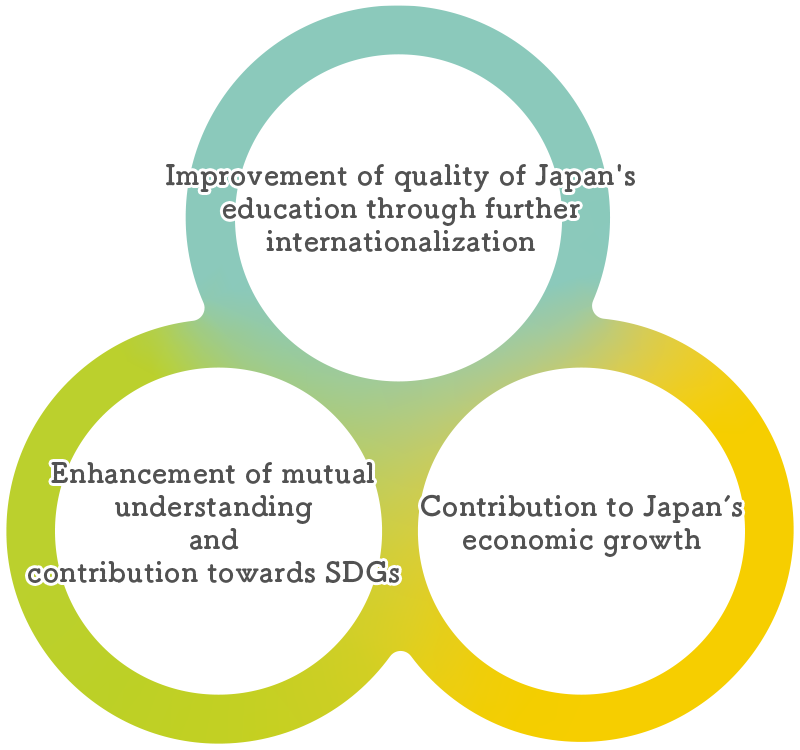
Improvement of quality of Japan’s education through further internationalization
- Further internationalization of education programs
- Capacity development of teacher and staff
- Capacity development of student and trainee
- Global human resources development
- Encouraging acceptance of international students/trainees studying in Japan
Enhancement of mutual understanding and contribution towards SDGs
- Enhancement of mutual understanding and contribution to the international society
- Strengthening relationships among countries through education
- Contribution to achieving SDGs, ESD
Contribution to Japan’s economic growth
- Supporting business expansion overseas in education
- Contribution of human resource development for Japanese organization in abroad
The concept of EDU-Port Japan is “port-port”.
EDU-Port Japan aims to expand horizontally and deepen the platforms built to date while reaffirming that EDU-Port Japan is “port-port”. It is based on the image of ports around the world where people, goods and information gather and information is shared and disseminated after new value has been added. In other words, “port-port” means that Japanese model of education leaves ports in Japan and arrives at ports all over the world where it is accepted by many people and finds new value before returning to ports in Japan.
Our Logo
The main concept is “Richness”
By organically placing different colored circles, the design illustrates the richness of the heart, where we focus not only on “studying”, but also a diverse education where we can enrich children’s culture and morals.
The colorful circles represents how different colors and cultures of each countries are respected on introducing Japanese-style education, meaning that Japanese style-education is never forced to any context. By doing so we can truly achieve the enrichment of every nation. These circles also represent the rich nature of Japan, which change its colors through out the four seasons.
The circles formulate an even larger circle. It represents our hope that the chain reaction of both good aspects of Japan and other countries can lead to the economic and spiritual enrichment of every nation.
Lastly, the set of circles are inline to create the letter “E”, symbolizing our project, EDU-Port.